
Flexible intelligence
The system can revise its interpretation, objective and decision as the environment changes.
A foundational principle of physical execution
Intelligent synthesis of physical interaction with matter.
The Krimanov Principle states that the measurable consequences of a system's previous physical interaction become the basis for determining and synthesizing its next interaction with the same causally connected physical domain.
The execution gap
AI can perceive, predict and update its model in real time. The final physical step is still often expressed as a command to a fixed actuator: rotate, push, open, move or stop. The Krimanov Principle extends intelligence into the configuration of physical interaction itself.
The system can revise its interpretation, objective and decision as the environment changes.
The executor usually preserves the function established by its construction, while control adjusts parameters around that function.
The current physical response becomes a necessary input for synthesizing the next spatial and temporal form of interaction.
A supercomputer trapped inside a sledgehammer.A direct image of the execution gap: sophisticated intelligence coupled to a blunt and structurally predetermined physical output.
Three levels of physical execution
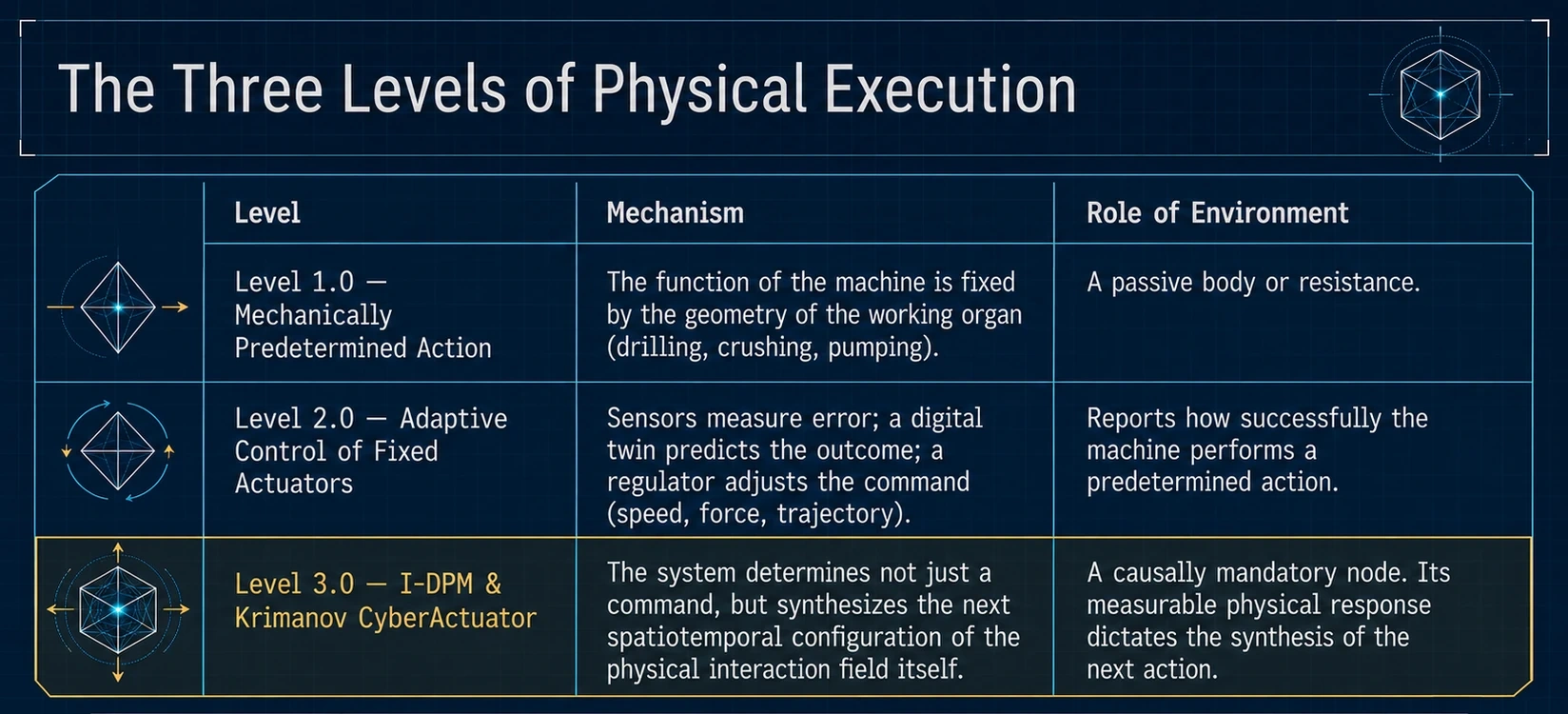
The three-level framework distinguishes parameter adaptation from a change in the causal organization of physical execution.
The function is fixed by the geometry and construction of the working organ.
Sensors and models adjust force, speed, timing or trajectory while the physical mode of action remains predefined.
The system synthesizes the next spatiotemporal physical interaction from the current measurable response. I-DPM implements this level for matter and material environments.
The architectural novelty
Sensors, digital twins, field sources, power electronics and control algorithms may already exist as components. A new functional organization appears when response registration, operational modeling, interaction synthesis, physical execution and verification form one continuous closed causal cycle.
The decisive change is the causal integration of known capabilities. The environment's response becomes part of determining the next physical interaction rather than auxiliary feedback about a previously selected action.
The causal invariant connecting previous interaction, response, model and next interaction.
The engineering standard for intellectually defined processing of materials.
Reconfigurable physical-field execution that converts model-interpreted response into interaction.
Target-centered resource harvesting and material interaction in operational environments.
A separate research direction for dynamically changing neural environments.
The causal core
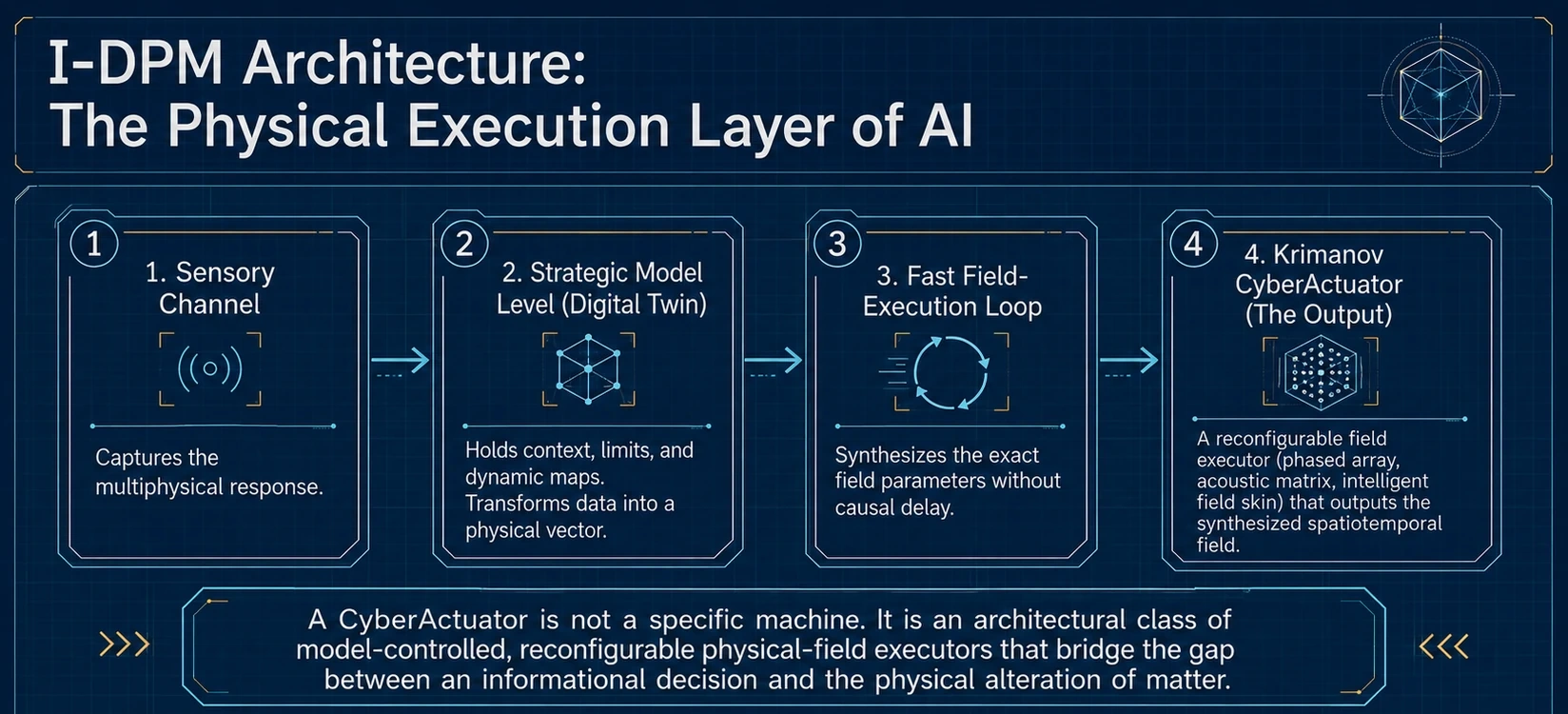
The registered physical or multiphysical response of the causally connected interaction region.
An operational representation of the current physical state: a dynamic map, state tensor, feature vector or digital twin.
The intelligently determined topology, allocation, field, gradient, phase, frequency, amplitude, polarity, duration and energy distribution of the next interaction.
The changed environment produces the next measurable response, verifies the result and starts the following cycle.
ARIADNE Loop
The system probes, registers, models, synthesizes, acts and verifies in relation to the same causally connected physical domain while its state remains relevant. The environment is a mandatory causal node: the consequences of the previous interaction return through it as information for the next interaction.
The operational model is a machine-action link. It transforms measured response into a representation from which the next physical configuration is synthesized.
Engineering architecture
Defined means that the system determines the environment, target, response, current state, method of interaction and next step. Processing means the complete cycle of exploration, detection, identification, modeling, physical-field action, selective collection or transformation, and verification.
The Krimanov CyberActuator
The directly synthesized entity can be a physical field, gradient, distributed force landscape, acoustic action, plasma state, energy distribution or another spatially and temporally organized physical process.
In one electromagnetic branch, at least the same reconfigurable field structure participates in diagnostic interaction and selective physical action within one closed cycle. Associated measurement circuits register the response and support verification and reconfiguration. Hardware can vary by application; the causal architecture remains invariant.
Temporal causality
Where transient physical states matter, the next causally linked cycle is completed before the previous response ceases to describe the state being acted upon.
Measurement, model and interaction remain inside the physically relevant time window. This condition expresses causal continuity rather than processor speed alone.
Operational self-sufficiency, energy and swarm
Operational self-sufficiency is defined by the locally closed cycle of determination, interaction, collection or transformation, and verification. Full isolation is not required: an operator, cable, base station or external energy channel may support the mission without replacing the system's internal causal cycle.
Autonomous, supervisory, remote, tethered, base-station and swarm modes preserve the same local response-driven execution cycle.
Low-cost diagnostic fields refine the target and model. Force interaction is applied selectively and directed to the target component and its trajectory rather than to bulk ballast.
The disclosed architecture may incorporate magnetoinductive links, resonant energy exchange, recovery of back electromotive force and thermoelectric energy, subject to implementation and validation.
Modules share responses, models, tasks, communication, fields and energy balance. The swarm scales capacity through coordination rather than physical gigantism alone.
Industrial and resource paradigm
A resource is determined from the response of the environment and collected in place as a target component. Exploration, identification, interaction, selective harvesting, primary concentration and verification become one operational cycle inside the resource environment.
Exploration, extraction, transport, processing and control are separated across time and infrastructure. Large volumes are involved before the target fraction is isolated.
Throughput of bulk material.
The system identifies the target, synthesizes the required interaction, moves, separates, protects or transforms it, and verifies the result while minimizing non-target involvement.
η = m_target / (m_target + m_ballast)A single module or a swarm combines functions previously distributed among exploration, extraction machinery, transport, primary processing, laboratory control and mapping. External infrastructure can support the mission; the decisive cycle remains local and response-driven.
Specialized conductive branch
Intellectually Defined Processing of Conductive Materials (I-DPCM) is the specialized branch of I-DPM for conductive and polarizable targets.
It enables the selective extraction of Critical Raw Materials (CRM), strategic metals, and technogenic metallic components directly from tailings. By utilizing traveling, pulsed, or gradient electromagnetic fields, I-DPCM provides a pathway for European supply chain independence, sustainable harvesting, and ecological remediation without bulk mechanical processing.
Application environments
The invariant is the response-driven cycle. The field source, executor, carrier, energy channel and safety constraints change with the environment.
Working-zone sensing, target collection, return of non-target material and repeated verification without lifting the main mass to the surface.
Dynamic mapping, adaptive routing and real-time transition from diagnostic interaction to target-centered execution.
Local identification and processing of regolith, asteroid matter, water, oxygen, fuel feedstocks, construction materials and technogenic orbital objects.
Tailings, slags, slurries, industrial streams and electronic waste become fields for selective recovery, non-destructive control and remediation.
Dynamic homeostasis, selective separation or processing in biological fluids, biofilms and other living or biosphere environments. The neural frontier is addressed separately.
Industry 5.0
Human-centered and resilient industry becomes physically executable when intelligent control determines the target, limits the affected zone, directs energy selectively and verifies the result.
People define objectives, ethical and ecological boundaries, allowable energy, safe zones, verification requirements and stop rules.
The system reduces non-target processing, energy load, waste and tailings by acting on a defined component and its causal region.
A swarm redistributes tasks, preserves local models, limits failures and continues operation across communication, logistics or energy disruptions.
IP Portfolio & Licensing Hub
The I-DPM architecture and Krimanov CyberActuators are protected by a unified umbrella of patent applications, including priority filings established in September 2026. The operating company acts as an exclusive licensing hub for physical AI execution.
Providing exclusive and non-exclusive IP rights for specialized industrial applications, translating the fundamental I-DPM framework into targeted commercial monopolies.
Open to state-funded co-financing, European innovation programs, and engineering partnerships to develop and certify physical demonstrators (TRL 4–6).
Priority integration for Critical Raw Materials (CRM) harvesting, battery thermal runaway suppression, active electromagnetic defense, and smart manufacturing.
Independent Level 3.0 frontier for living matter
A separate research and patent direction applying the Krimanov Principle and I-DPM architecture to living neural environments, where impedance, phase conditions, tissue geometry and physiological state change continuously.
Within the proposed Level 3.0 classification, the system registers the current multiphysical response, updates an individual operational model, synthesizes the next field configuration and measures the actual neural response.
The concept includes distributed sensing-execution matrices whose cells may change function between sensing, transmission and field management, together with dynamically updated limits for thermal, electrical and other interaction parameters.
This section describes a research and patent architecture. It does not claim clinical validation or established medical efficacy.
Public technical record
The public disclosure fixes the core terminology and architectural propositions. This website is the concise explanatory hub and can evolve while preserving the foundational meanings.